Thursday, October 29, 2009

Swift swift swift...

...that is not the title of the two following stanzas but it is the title of this post.

Swiftly sweeps the stream,
and by it I am caught
in a host of assumptions
of what you are not.

Fair maiden's laugh--
Fair maiden's game.
What is fair? to mine
own eyes, thy shame.

I am pretty sure that I have not already posted these two little stanzas...if I have, simply ignore this post.

Sunday, September 20, 2009

A Seraphic Sight...

Do not be deceived. This is not a commitment.

I would love to return to consistent posting but I am not able to just yet.

While talking with my sister about Bonaventure I looked at the back of my copy, where I found, scribbled in my messy manner, a poem that I wrote while reading Bonaventure. It is a prayer and I thought I would share it. It goes:

Shine through dim pages were fiery words are writ,
And light a flame this mind with the Fire with which You inspired it.

Till all shall yield to the all consuming fire,
And hope, love, thoughts speed by the force of fully taught desire.

Love my loveless heart, O LORD, unto desire...
That I, by Thy love, may to heaven aspire.

Carve upon these lifeless leaves, till the
coarse skin gives way and bleeds.

Tuesday, January 06, 2009

"I See the Sky and Wait"

This was born out a day of watching the sky and saying "I must write something!" This is also an old one (around a year ago). I actually showed it to Karyn once (around the time I met her) and then never touched it again. It was written in one sitting and has not been edited since. It took me about a half an hour of just looking at the sky. Surprisingly every line that I wrote was 10 syllables exactly except for the 3rd...well, that's not entirely true: though I did not edit the lines I did take out about 8 lines between the 3rd and 4th...that also explains why it seems so abrupt. I have given up on feet for now. I later found a poem from Diary of an Old Soul that sort of captured what I wanted to say better than I could:

“My halting words will some day turn to song—
Some far-off day, in holy other times!
The melody now prisoned in my rimes
Will one day break aloft, and from the throng
Of wrestling thoughts and words spring up the air;
As from the flower its color’s sweet despair
Issues in odor, and the sky’s low levels climb”
—George MacDonald, October 30th

10 Pastels that are pale at my pen are pearls—
10 So smooth a sea before me lays—precious
To me.
10 The horizon swallows the pearly sea
10 In Tragedy’s veil and Love’s canopy.
10 Skies seething form another scene—a scape,
10 My heart a bursting, barred with locks that none
10 So strong an emotion, howe’re it be,
10 Bold for beauty, cannot seem to escape
10 with caper Words, on ladder Melody,
10 And so held in I fear that I am done—
10 Who can hold in his heart passion’s fury
10 As sinks the golden, somber, setting sun?
10 See the sky in dying embers lighten
10 While yet growing dim in the waking west,
10 The day’s work is done, now to the East then
10 I turn to await the rising Sun. Best
10 Is the life I’ve chosen, come Lord Jesus
10 Come, and set free then the beauty in us.
10 The pastels are pale at my pen—wake pearls!
10 Skies are aging fast into stern aged grays,
10 So soon succeeded by death’s blacked depth
10 The Days wait earnest in their living grace
10 To be redeemed. And God shall set them free.

Monday, January 05, 2009

Fleeting pleasures when considered are pains...

I wrote this a long time ago (a year? two years ago?). It started with a reflection on a life of hedonism and I thought that this self-indulgence is actually (paradoxically) pain when soberly considered in view of the end of such self-indulgence end (sort of consistent with the theme of my last post but a little different...I don't think they disagree but then I have not thought about it much).

A 10 Fleeting pleasures when considered are pains
B 10 One must forgo if he would have his heart
A 10 Be glad, so that he may the greater gains
B 10 Receive--though fantastic he had--to part
C 10 And join to hope. That in eternal clad
D 10 Abounding in riches, we may put off
C 10 Gold--we cannot loose what we never had.
D 10 Let’s put on what can never be put off.

On a side note, Fred Sanders has brought to my attention in his blog post on Jim Elliot that Elliot said something similar, “He is no fool who gives what he cannot keep to gain that which he cannot lose.” I agree Jim! Nothing could separate you from the love of God in Christ--O the glorious treasures that you have been called to in Christ Jesus our Lord! God Bless you saint.

Here is another one written around the same time (before the other one):

10 Let us then sing praise, and worship our God
10 For what we have and have not, indeed for
10 ‘Tis better thus for us to lack and laud
10 Because if He who can does not out pour
10 Wealth, our having would make us all the poor
10 Of health. Let us forever praise our God!
10 As the father withholds from his child
10 The ill, so you my Lord restrain our wills—
10 Moderate in Thy steadfast love mild
10 So that we may know the great love that fills
10 And be made too Thy very own child.

Sunday, January 04, 2009

"What times we've had"

I like the first two stanzas, chiefly because they are simple and say what I want to say, but after that I feel like I tried too hard to say more and don't say what I want to say, plus I am looking for one more stanza to end it with while getting rid of one or two or three of the stanzas I already have. I wanted to end it on more of a triumphant note. Something having to do with the redemption of time, see A Romance to Remember by John Mark Reynolds, or The Great Divorce, in which Lewis says it so well through the mouth of MacDonald:
'Son,' he said, 'ye cannot in your present state understand eternity: when Anodos looked through the door of the Timeless, he brought no message back. But ye can get some like-ness of it if ye say that both good and evil, when they are fully grown, are retrospective. Not only this valley but all this earthly past will have been Heaven to those who are saved. Not only the twilight in that town, but all their life on earth too, will then be seen by the damned to have been Hell. That is what mortals misunderstand. They say of some temporal suffering, "No future bliss can make up for it," not knowing that Heaven, once attained, will work backwards and turn even that agony into a glory. And of some sinful pleasure they say "Let me but have this and I'll" take the consequences"; little dreaming how damnation will spread back and back into their past and contaminate the pleasure of sin. both processes begin even before death. The good man's past begins to change so that his forgiven sins and remembered sorrows take on the quality of Heaven: the bad man's past already conforms to his badness and is filled only with dreariness. And that is why, at the end of all things, when the sun rises here and the twilight turns to blackness down there, the Blessed will say, "We have never lived anywhere except Heaven," and the Lost, "We were always in Hell." And both will speak truly.'
Sorry that it's so long, but the whole quote is necessary. The "was" IS in the end, or the end that IS classifies the "was"...or perhaps a better way to put it is, "the end characterizes your life here and now, since all that happens here has the end as the consequent." You cannot count the damned man really happy here when all that is here leads to Hell, away from ultimate happiness, you can only count his indulgence serious loss. There is a better way to put it and I think that both Boethius and Aquinas have a lot to contribute to this discussion...but I better post this or else I will think about it till I forget. All this to say: I had this idea in my head when writing the poem; I want to work this point into it; but I do not know how to accomplish this.

8 We have had such times that steal us,
6 that keep us till we're old,
6 and hold us in our youth,
6 and wait to be retold.

8 We have had such times that bleed us,
6 till life becomes a cry,
8 and hopeful longings go before us
6 all wanting us to die.

8 We have had such times that judge us,
6 that weigh our many sins,
8 and hold a witness against us—
6 our chains that we march in.

8 We have had such times that strip us
6 that lay bare our lamed souls
8 and make a show/sport of our despairs
8 and bade to the bellowing woes.

8 We have had such times that jade us
6 that take our tender thoughts
8 and make us shame sincerity
6 till twist’d in sinful knots

8 We have had such times that free us,
6 that break our fearful bonds,
8 and carry over witless crags,
6 our souls to seize the dawns.
Monday, December 29, 2008

Improv...

I wrote this in about 20 minutes...It was inspired by Nicole. I walked into my room and said to her (with an unsettled tone) "something is a-foot my dear, something is a-foot my dear." I repeated this, never the same way twice. She then begged me to stop the madness and so I did. I think this little work is best when read with that voice...it is the voice with which I read T.S. Eliot. Enjoy...or don't.
---
Something is a-foot my dear, something is a-foot my dear...
the gamboling shades dote upon the shrub, while Luna
makes her way no further than above heaven's leaves,

O, Something is a-foot my dear, something is a-foot my dear...
see them romp and find a solemn tune, while heroes
fall and ladies over worn take to swoon in the muddy mire,
see them behave in a way most dire and daring to dare my dear.
drinking deep of the darkest fire.

Something is a-foot my dear, yes, something is a-foot my dear...
see the sights transpire till all confound the truest Fire
and make their homes within the ground and leave to lies
the midnight hour haunts and surprise suffuses like dread
in the sweetest sounding abuses, and muffle cries in mire,
drinking deep of the darkest fire.

Something is a-foot my dear, something is a-foot my dear!
They wake and wring desire till all turn to the darkest fire--
see how low the shades aspire when hope is/has but to suspire
in delusion's mirror and the fairest face they see is near and there--
when they drink deep of the darkest fire.

A last thought 'fore parting, my last Thought's to do:
They shut themselves in darkness,
in darkness, not the light.
He shuts them up in darkness,
in darkness in the light.
---
(If you would like me to read this too you sometime with the strange, disturbing voice it would be my pleasure.)

Tuesday, July 31, 2007

Exerts from my "Canterbury Tale," and Vision.

"Hark now prim company, hearken to this tale

For not a word is spoke in vain but well

For you to take to heart what is spoke. Lo!

The tale begins!"

[...]

"At noon the poet sits in his parlor

Looking over the infested harbor,

Bustling with the lives of men so low,

That to converse one must honor forgo.

Fostering contempt—his paint and platter—

Contempt for the lowborn, layman ladder."

[...]

"Lone the poet calling Melpomene,

Teary eyed, besought by Nyx, and finding

To lust with pen easier than pining

With the times in truth and sobriety."

[...]

“'Play on! My heart does not afford me rest,

With luck your melodies shall sooth distress.'

But fore the harp was crooned or coyly pressed

There sank a shadow by pass of Erebus"

[...]

"Be gone thou my words, my silken-sheets,

Thou art sin stained garments of verse—a hearse

For my love past, a precession that speaks

Of past defeats and love ill-spent, accursed."

[...]

"Thou art an ardent declaration, fain

Of spite’s ill-gains and stains"

[...]

"My ivory tower of verse looming high

That beckoned the pagan hearts, 'Hither—nigh!'

Shall topple and tumble to ruin"


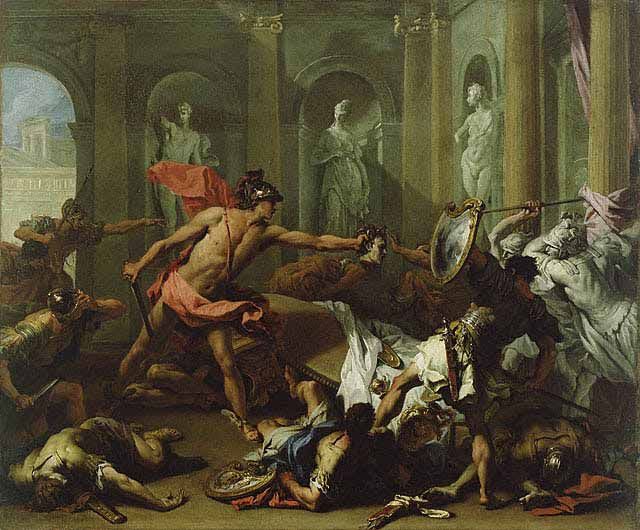
(For Chaucer's Canterbury Tales our class was given the option: write a six page tale or a reflection essay. Over break I attempted a Christian tale with pagan elements called "Thaetus." This was influenced by the Knights tale, who, being Christian and of the highest social rank, gives a tale that has many pagan characters. I had hoped to gain insight through this process into why he does this. The Story was as follows: Thaetus is a poet who is quite immoderate with his emotions and it is this unbridled passion that produces the conflict in the story. The tale was to show a few elements of emotions, (1) their potentially deceptive nature, (2) irrational nature, and then finally (3) the beautiful fruit and necessity of a heart focused on God in living a godly life. Now Thaetus, for the sake of art and pleasure, indulges in every emotional sensation that comes his way, being a man who habitually sulks in sorrow, and to gluts in laughter (however temporal), and so on and so forth. At the heart of the story I wanted to set Matthew 5:38-42 and Proverbs 4:23. The way in which I intended to achieve this, was to created conflict--namely anger: Thaetus is severely wronged and responds in anger, an anger that many would consider righteous, but as the wind carries the chaff, so is he carried by these passion. Most of the message in short is: Being right does not purify a wrong attitude or behavior. It is more dangerous for a Christian (or more universally, a man in general) when he is right in a conflict than when he is wrong, because he is more likely to become bitter, more reluctant to let go of an offense and forgive, and likely to be deeply hostel when someone has cheated him or taken advantage of him. A Christian is more likely to sin by his reactions than his actions--perhaps this is one reason why we are to to turn the other cheek--for what the devil can do with our anger. To add more elements to the story I added a character named Tactus, a daemon who steals/collects faces. At Thaetus' severely uncouth behavior Tactus is given permission--nay, orders (which he joyfully exploits) to seize the poet's face (that is, literally rip it off...I thought it appropriate to the image in my head to have him perform such a task for his master). So when Tactus, the face stealing daemon, comes to Thaetus (who is in the very act of his lewd, unsightly poetry, fostering contempt) he is terrified, disoriented, and sick as he has his crime and punishment reported to him. Due to certain rules that Tactus must work by, Thaetus is given time to consider his ways. During this time of deliberation he must offer a heartfelt repentance, but he finds that he is unable to change his own heart. He must "safeguard his heart," but how? Such is his dilemma. He then engages in conversation with various past poets--that is, the faces of past poets that Tactus has in his sack, but he finds them to be of little to no help, seeing that they all failed to find the answer to their pressing dilemma. Although, they do offer their attempts as examples and demonstrate the ways in which one cannot succeed in change his heart. In the end all is well and quelled. I am sure I am leaving more out, but if you are at all curious or have any advice or questions, I would love to hear them. God Bless.)